

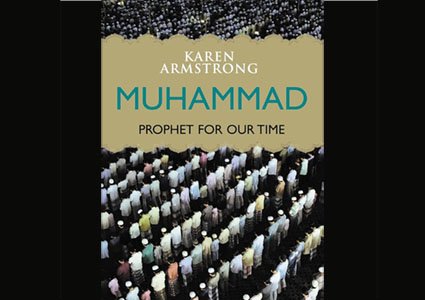
by Karen Armstrong
A seeker’s reflection — not a critique, but a conversation with the book.
✍️ Who is this author, and why does she write?
Karen Armstrong is not Muslim — and yet, her writing carries the weight of deep respect and sincere effort to understand. A former nun, her religious journey led her to study faiths not as labels, but as human attempts to make meaning. Her works on comparative religion show a rare empathy, and this book is her quiet offering to correct the many wrongs done to the name of the Prophet ﷺ in the modern world.
She writes because the Prophet Muhammad ﷺ, to her, is too important to be misrepresented, and perhaps too noble to be ignored by any heart that seeks truth.
What did I first open to?
I didn’t begin from the introduction. I flipped to a chapter titled:
“Holy War” — not because of controversy, but because of clarity.
In an age where his name is invoked for the wrong reasons, I wanted to hear how someone outside the ummah understood his ethics in war.
What I found was not just a defense, but a gentle unveiling: a Prophet who forbade cruelty, protected civilians, and taught that inner jihad was greater than any sword.
It reminded me that we often know a man best by what he forbids.
What stayed with me?
- The Prophet ﷺ as a unifier — not a conqueror She paints a portrait of a man who healed tribal wounds, restored dignity, and won hearts before battles.
- Spirituality and politics weren’t at odds For him, justice and God-consciousness walked side by side. Leadership wasn’t about power — it was trust (amānah).
- Modern Islamophobia relies on historical amnesia Karen Armstrong reminds us that the Prophet ﷺ was admired by many early Western thinkers — before the age of imperialism twisted narratives.
What did it make me reflect on?
I realized this: even outsiders can become allies in truth.
Her lens is not that of a believer, but of someone who looked with care. And that care is a kind of justice.
It made me wonder — are we, as Muslims, willing to read our own Prophet ﷺ with this much reverence and curiosity?
Do we still tremble at his mercy? Do we study his silence as deeply as his words?
Who is this book for?
- Non-Muslims trying to understand Islam beyond headlines
- Muslims who’ve drifted and want a gentle re-introduction
- Teachers, writers, seekers — anyone whose heart is still open to truth
A line that lingered:
“We must approach the life of the Prophet with the same passion with which we would read a love letter.”
Final Note:
This isn’t a scholarly sīrah. It’s a bridge. And sometimes, bridges are exactly what we need — not to dilute the truth, but to reach more hearts with it.
BookReview #SpiritualReading #IslamicStudies #ProphetMuhammad #FaithJourney #SeekerReflection #MindfulReading #iSeekIslam #ReligiousEmpathy #IslamicScholarship #SpiritualGrowth #FaithExploration #ThoughtfulReading #InterfaithDialogue #ContemporaryIslam #InnerJihad #MeaningfulBooks #IslamicBooks #CreativeReading #IslamicReflection