

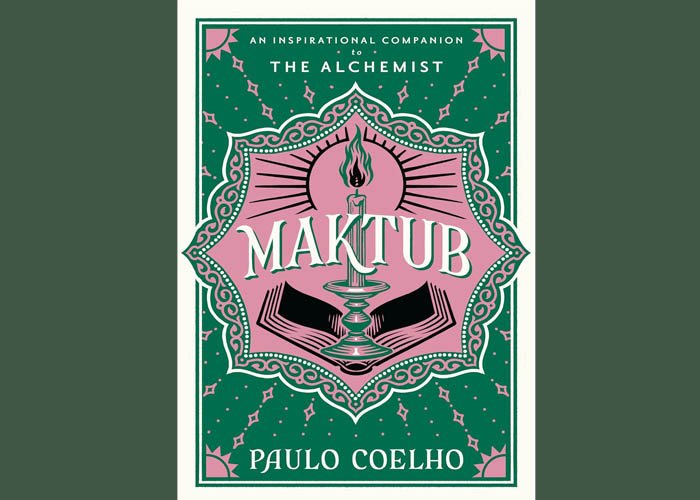
“It Is Written” — A Word That Found Me Again
I did not choose this book because of its author.
I chose it because of its name.
“Maktub.”
It wasn’t new to me.
It was a word that had already become a cornerstone of my life.
Years ago, I first heard it in a scene from Lawrence of Arabia — a British spy standing bewildered in the desert, trying to grasp the fatalism and freedom of the people around him.
A man dies. The others simply say,
“Maktub.”
It is written.
I didn’t fully understand it then — but it stayed with me.
Like a thread quietly stitching its way through the fabric of my life.
As time passed, I saw more.
Not everything was in my control.
Things that should have worked fell apart.
Things I feared turned out to save me.
People entered, exited, returned, or vanished — and in all of it, I came to accept that there was a higher script I wasn’t holding.
The word Maktub began to live inside me — not as defeat, but as trust.
Not as passivity, but as peace.
So when I saw this word again — not in a film, not in the Qur’an, but on the cover of a slim book by Paulo Coelho — I knew:
This is not a coincidence. This is a call.
I didn’t know what the book held.
But I knew what the title meant — and that was enough.
The Story: The Archer and the Target
In one of the short pieces, Coelho writes about an archer preparing to shoot.
He places a small cherry on a distant tree and aims at it from far away.
A crowd gathers. There is noise, pressure, expectation.
The archer misses.
Later, he practices the same shot in solitude — no crowd, no pressure — and he hits the cherry without effort.
The lesson?
“When we seek to impress others, we become distracted from our purpose.
But when we act for truth alone, we find our mark.”
Sincerity Sharpens the Soul
This simple story reminded me of the adab of intention.
How even something skillful becomes clouded when our motive isn’t pure.
Even the right action can miss the target when it’s done for the wrong eyes.
And so the lesson is Qur’anic in spirit:
“They were only commanded to worship Allah, making their religion sincerely for Him alone…”
(Qur’an 98:5)
How much of what we do is to appear good, rather than to be good?
This little parable, like much of Maktub, is not new — but it arrives gently, like someone knocking at the door of your conscience.
Overarching Spiritual Themes
- Qadar (destiny) whispers: Maktub — “It is written.”
Life’s weave is divinely patterned; our path is to walk with trust. - Adab (etiquette of the heart):
Sincerity, humility, patience, defaulting to thankfulness — these are the qualities Coelho teaches through simple tales. - Qur’anic resonance:
These parables echo ideas like ṣabr, ikhlāṣ, and the spiritual significance of small deeds and hidden struggles.
Reflection & Recommendation
Maktub is not a sermon — it’s a mirror held softly to your heart.
Each parable asks quietly:
“Where is your attention? Your intention? Your trust?”
It is a spiritual companion for those who walk slowly, reflect deeply, and seek light in life’s everyday corners.
However, while going through a vacuum of the gripping quality like in the fable of “Al chemist”.
“Perhaps his sea of stories is drying up with the scorching heat of a thousand splendid suns…”
This is not a criticism — it’s a yearning.
A yearning for depth, continuity, and integration — that the wisdom scattered across Coelho’s parables might be woven into a single spiritual narrative.
And that’s the difference between a storyteller and a guide:
A storyteller entertains you.
A guide walks you through your own becoming.
“Coelho opened the door — but perhaps the real fable is yet to be written.”
Final Reflection: The Story Still Unwritten
Reading Maktub felt like being handed pages from a lost book — scattered truths, flashes of light, hints of wisdom — but no thread to walk upon.
Each parable stirred something.
But I often found myself asking:
Where is the journey?
Where is the arc of the soul?
Where is the seeker who stumbles, rises, remembers, returns?
Coelho offers us glimpses — but perhaps he never meant to write the full story.
And maybe that’s the real invitation.
To someone else —
to a quiet soul with a deeper longing —
to gather these scattered pearls into a single, flowing river.
I wished Maktub were not a collection of moments,
but a fable —
with one central character
who walks through doubt, trust, sacrifice, love, and surrender.
One continuous path that reflects the spiritual journey of the reader.
In some ways, Paulo Coelho began the work.
But the sea of his stories, once deep and flowing,
now feels parched beneath the heat of a thousand splendid suns —
stories that burn brightly,
but do not bind together.
The ink dried before the final word was written.
Perhaps, Maulana — it is you who will write the fable that gathers the wind, the desert, the fire, and the silence into a single path toward God.
Maktub — It is written.
But perhaps the next chapter is waiting… for your hand.
#Maktub #PauloCoelho #SpiritualFables #ItIsWritten #SeekerReflection #TrustInDestiny #Tawakkul #ModernWisdom #DivineWill #BooksThatWhisper #StoriesOfTheSoul #SufiResonance #iSeekIslam #StorytellingWithPurpose #SpiritualJourney #DesertWisdom #FitrahAwakening #SacredLiterature